Every year, the same question arises: LED or incandescent Christmas lights? The answer has changed dramatically over the past decade as LED technology has matured. This guide provides a comprehensive comparison to help you decide. For our full range of Christmas decorations, visit CGA Christmas Decorations.
The Great Christmas Light Debate
Christmas lights have evolved significantly. The incandescent bulb, unchanged for decades, now shares the market with advanced LED technology. The choice affects your electricity bill, display appearance, safety, and environmental footprint.
The Energy Star program for light strings provides efficiency ratings and helps consumers identify quality products.
LED Christmas Lights Explained
LED (Light Emitting Diode) Christmas lights use semiconductor technology to produce light. They require minimal power, generate negligible heat, and last virtually indefinitely under normal use.
Incandescent Christmas Lights Explained
Incandescent bulbs pass electricity through a thin tungsten filament, heating it until it glows. The design has remained essentially unchanged since the early 1900s.
Energy Consumption Comparison
LEDs use up to 90% less energy: A 100-bulb incandescent string draws ~48W. An equivalent LED string draws ~4.8W. Over a 30-day holiday season running 8 hours daily, the incandescent string costs ~$1.73 in electricity vs ~$0.17 for LED. For large displays with 50+ strings, savings exceed $100 per season.
Lifespan & Durability
| Factor | Incandescent | LED |
|---|---|---|
| Average bulb life | 1,000-2,000 hours | 25,000-50,000+ hours |
| Holiday seasons (typical) | 2-4 seasons | 20-40+ seasons |
| Breakage risk | High (glass bulb, fragile filament) | Low (solid state, epoxy encapsulated) |
| Single bulb failure | Whole string goes dark | Other bulbs stay lit (most series) |
Brightness, Color & Appearance
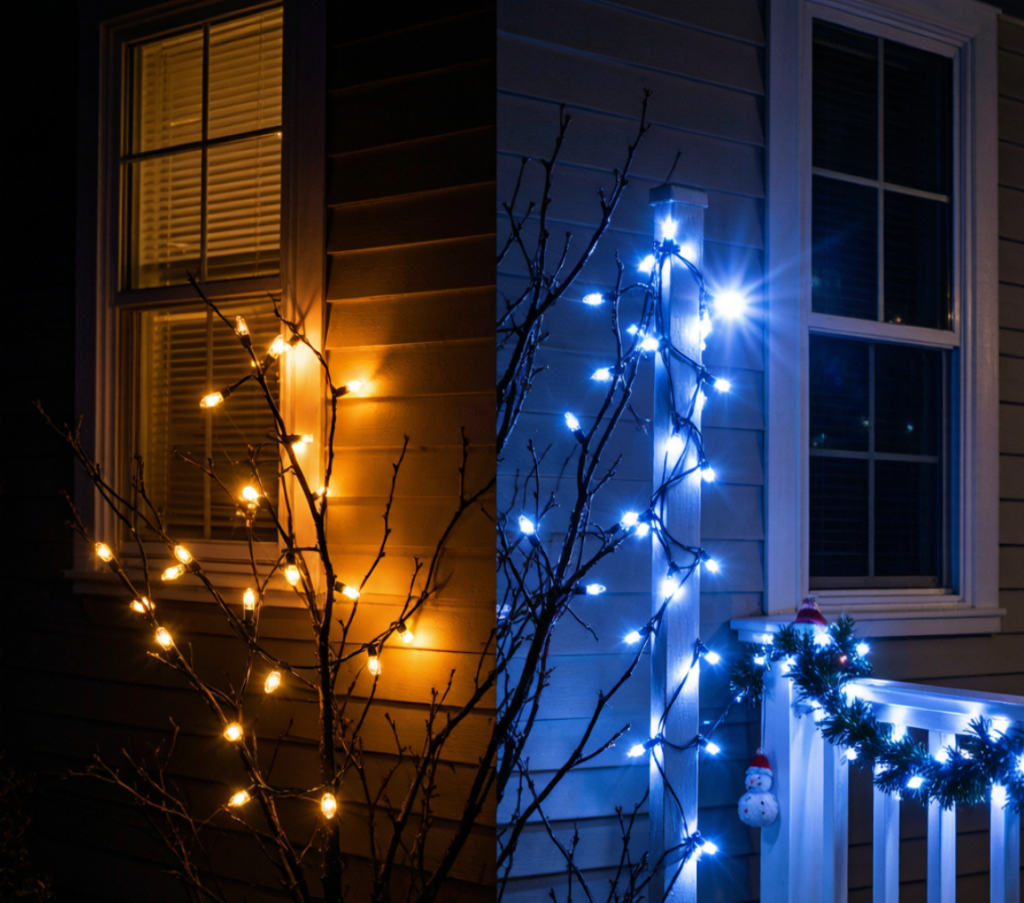
Modern LEDs offer superior color quality. Warm white LEDs at 2700-3000K match the classic incandescent glow. LEDs also offer color-changing, tunable white, and programmable patterns impossible with incandescent technology.
Safety & Heat
The NFPA (National Fire Protection Association) reports that Christmas tree fires cause an average of 160 home fires annually in the US. Incandescent bulbs can reach 100-200°F and ignite dry trees. LEDs remain cool to the touch.
Cost Analysis
| Cost Factor | Incandescent | LED (Premium) |
|---|---|---|
| Upfront cost (100-bulb string) | $5-12 | $15-30 |
| Replacement frequency | Every 2-4 years | Every 10-30+ years |
| 10-year energy cost | $50-150 | $5-15 |
| 10-year total cost | $70-200 | $20-50 |
Indoor vs Outdoor Use
LEDs excel outdoors: they function better in cold weather, are moisture-resistant with proper UL rating, and allow more strings to be connected without tripping breakers.
Environmental Impact
LEDs contain no mercury, produce less e-waste (last 25x longer), and significantly reduce power plant emissions through lower energy consumption. The Energy Star certification identifies the most efficient options.
Premium Christmas Lights from CGA
Looking for quality Christmas lights for your brand or project? CGA (Zhichen Artware) manufactures premium LED strings and decorative lighting systems with UL/ETL certification, consistent color quality, and customizable length/wire color. Ideal for wholesale, retail brands, and commercial projects.Explore CGA Christmas Catalog → | Request OEM/ODM Quote
FAQ
Are LED Christmas lights better?
Yes — 90% less energy, 25x longer life, safer, and modern LEDs match the classic warm glow.
Do LED lights look as good?
Yes — premium warm white LEDs (2700-3000K) are indistinguishable from incandescent to most people.
Can LEDs be used outdoors?
Yes — better than incandescent for cold weather, more durable, and more strings can be connected.
How much do LEDs save?
$50-200 per season for a typical household. Commercial displays can save thousands.
Are LEDs safer?
Yes — virtually no heat, no shattered glass bulbs, reduced fire risk per NFPA statistics.
Conclusion
LED Christmas lights are the clear winner across almost every metric — energy efficiency, lifespan, safety, and environmental impact. While the upfront cost is higher, the long-term savings and convenience make LEDs the smart choice for any holiday display. For commercial buyers and brands, LED is the only choice that meets modern energy standards and consumer expectations.